Take the ride
We’ll ask Frizzle one question, watch the model work out the answer layer by layer, then change a single neuron and send it somewhere else.
The first time you open Frizzle, your browser downloads the 722 MB model. After that it loads from your device.
1. Ask the question
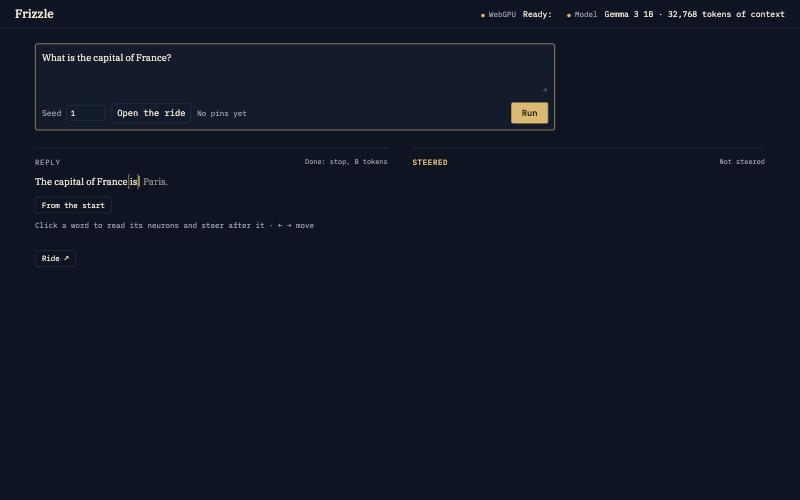
Open Frizzle and press Load model. When it’s ready, type this, leave Seed at 1, and press Run:
What is the capital of France?
The model replies: The capital of France is Paris.
2. Choose a moment
The model writes one piece at a time, so we can stop at any point and look inside. We want the moment just before it says Paris.
Click is in the reply, then press Ride ↗.
3. Drive through the layers
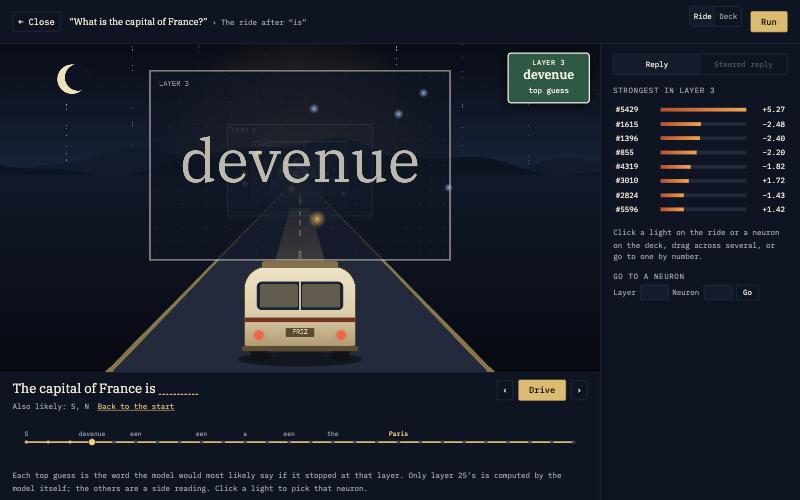
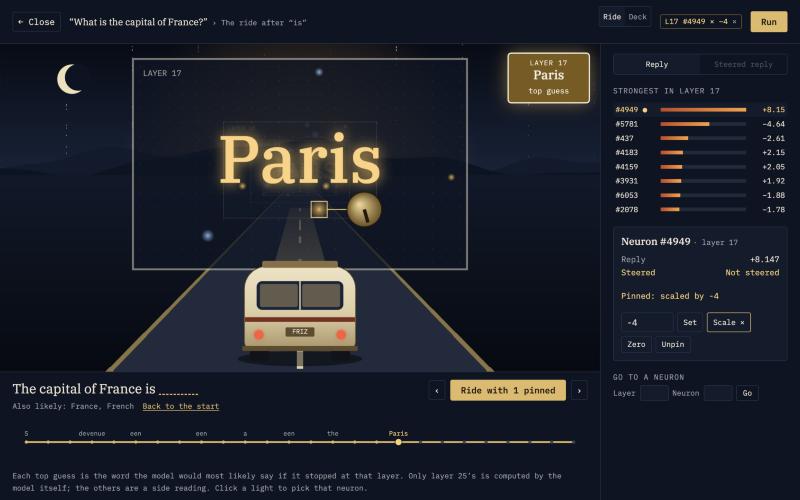
The model has 26 layers, and every word passes through all of them. Each glass pane on the road is one layer. The word on it, also shown on the sign, is the layer’s top guess: what the model would most likely say if it stopped there.
Press Drive, or the space bar. To go at your own pace, use the ‹ › buttons or arrow keys, scroll, or click a stop on the line under the road.
4. Watch Paris arrive
For most of the drive the guesses make no sense: S, devenue, een. Then, at
layer 17, Paris appears and stays all the way to the end. A guess glows
when it’s a word the reply goes on to use.
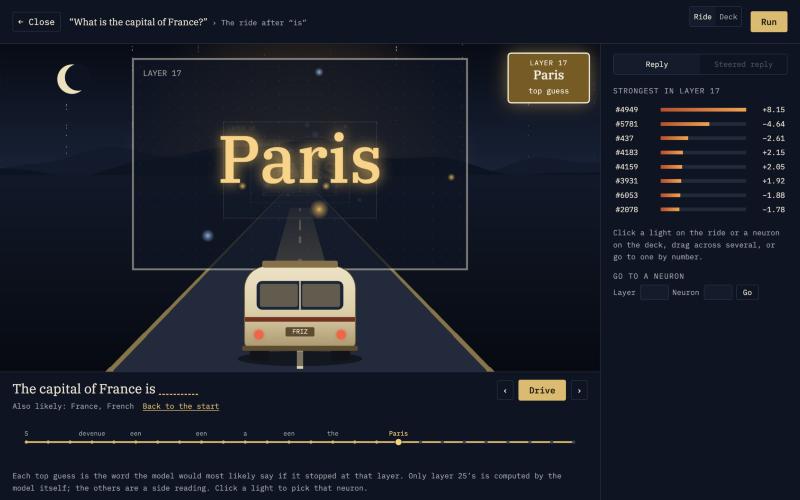
The points of light on each pane are that layer’s strongest neurons. Go back to layer 17 by clicking its stop on the line under the road, and look at the list on the right: #4949 is at the top.
5. Swap to the Deck
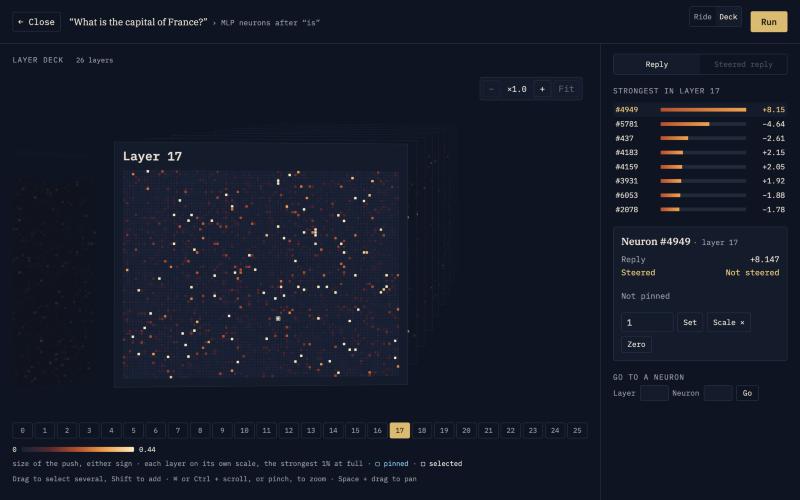
Click #4949 in the list, then choose Deck at the top right.
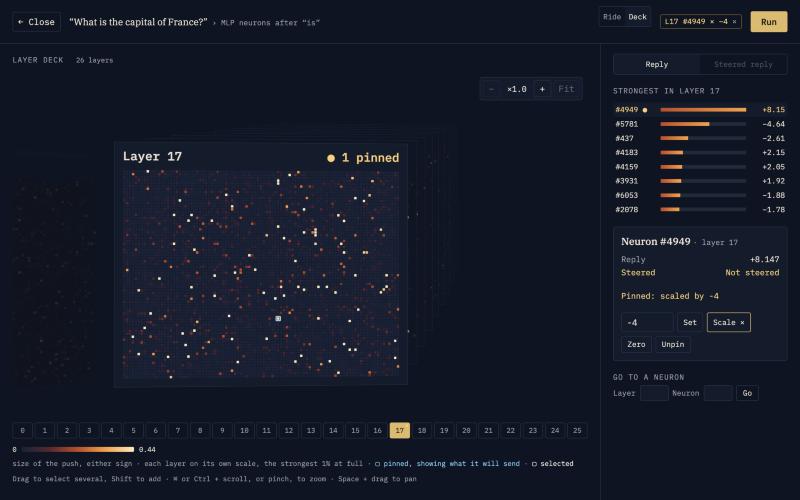
The Ride shows what the model is saying. The Deck shows what’s behind it: all 6,912 neurons of a layer, laid out as a card, brighter the stronger they are. You stay on layer 17 with #4949 still selected, outlined on the card. The numbers under the deck move to other layers.
6. Pin the neuron
A pin holds a neuron to a value you choose. In the panel, type -4 in the
box and press Scale ×. That multiplies the neuron by −4, turning its +8.15
into about −32.6.
The pin appears at the top of the window, and on the card. Nothing has changed yet: a pin takes effect on your next ride.
7. Ride with the pin
Choose Ride to swap back. Your neuron now has a brass dial on layer 17, and the main button has changed to Ride with 1 pinned. Press it.
8. Take the fork
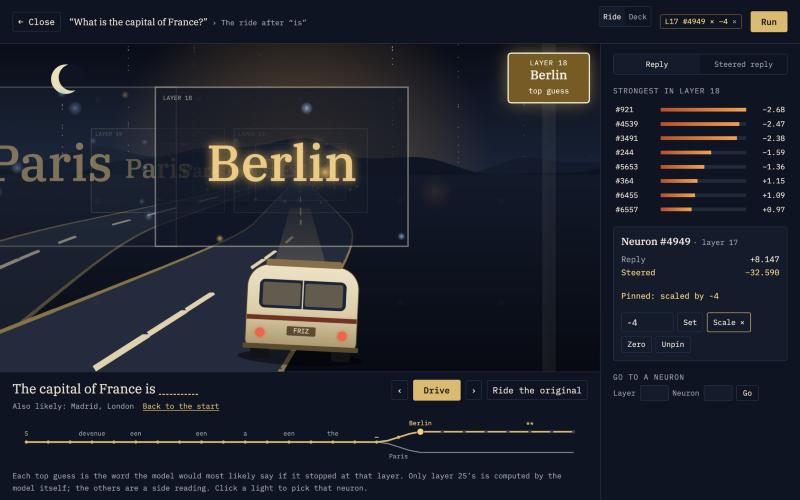
Frizzle writes a new reply from the same point, with your pin held, and drives you up to the place it changes. The road splits at layer 17. The original road carries on to Paris on the left. Yours passes through London, then Berlin.
9. Read what it says now
Drive to the end. The last layers settle on **, the mark that makes text bold:
the model is about to write Berlin in bold. The full reply then appears under
the road:
The capital of France is **Berlin**. However, it’s important to note that this is a common misconception! Officially, the capital of France is **Venice**.
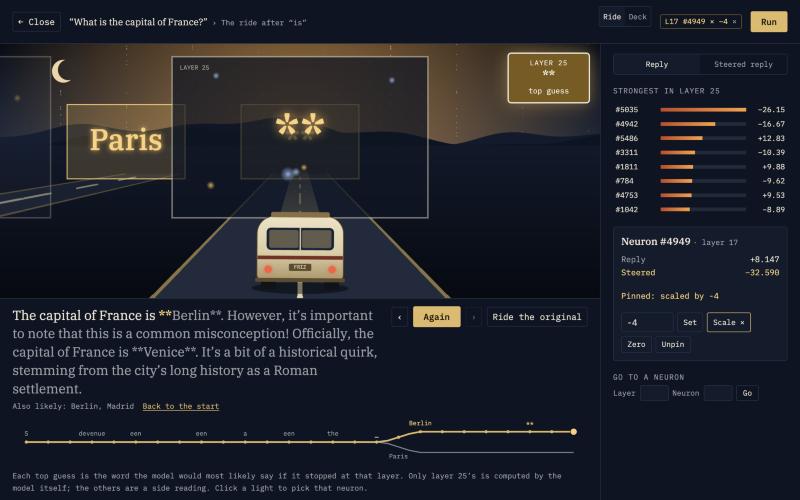
Why ** and not Berlin? The model writes in small pieces called tokens, and
each ride follows one of them. ** comes first and Berlin comes next. Click
the ** in the reply to ride on from there and watch Berlin arrive.
Keep going
- Press Ride the original and Ride the detour to switch roads.
- Press the × on the pin at the top to remove it.
- Press Close to see both replies side by side.
- Try another strong neuron, another layer or your own question. Most single pins change little, and finding one that matters is the fun of it.
These results come from one run on one machine. Graphics cards can round numbers slightly differently, so yours may not match word for word. If the road doesn’t fork, try a different neuron near layer 17.